
Islamic history · From the record
Islamic history, examined at the source.
Tarikhology takes the questions most often asked about Islam and answers them from the historical record itself — through essays, a podcast, documentaries and The Prophet’s Life, our interactive reading app. Education through history, for hearts and minds.
The library is free to read, with no account needed. The Prophet’s Life is £2.49 on Google Play and the App Store.
Watch and listen
Films and conversations.
Documentaries built from the chronicles, and a podcast that sits down with the people asking the questions.
- 01From Sultan to Caesar1 h 35 Documentary. Sultan Mehmed II’s ascension to glory and the taking of Constantinople, as the chroniclers recorded it.
- 02Understanding the US/Israeli war against IranEp 24 Podcast, March 2026. With Mahfuz Talukder, geopolitical analyst.
- 03Why I became a teacher after getting kicked out of schoolEp 23 Podcast, February 2026. With Jalil Bela.
- 04This one thing led me to IslamEp 22 Podcast, November 2025. With Ismail Abdul Azeem.
What’s inside
One organisation, six doors in.
Everything we make starts with a question and ends with a source.
-
I
The Library
Ten essays across five shelves — Foundations, Sīrah, Contested questions, Scripture and Comparative — each with a standfirst, a reading time and its references.
Read the library -
II
The Prophet’s Life App
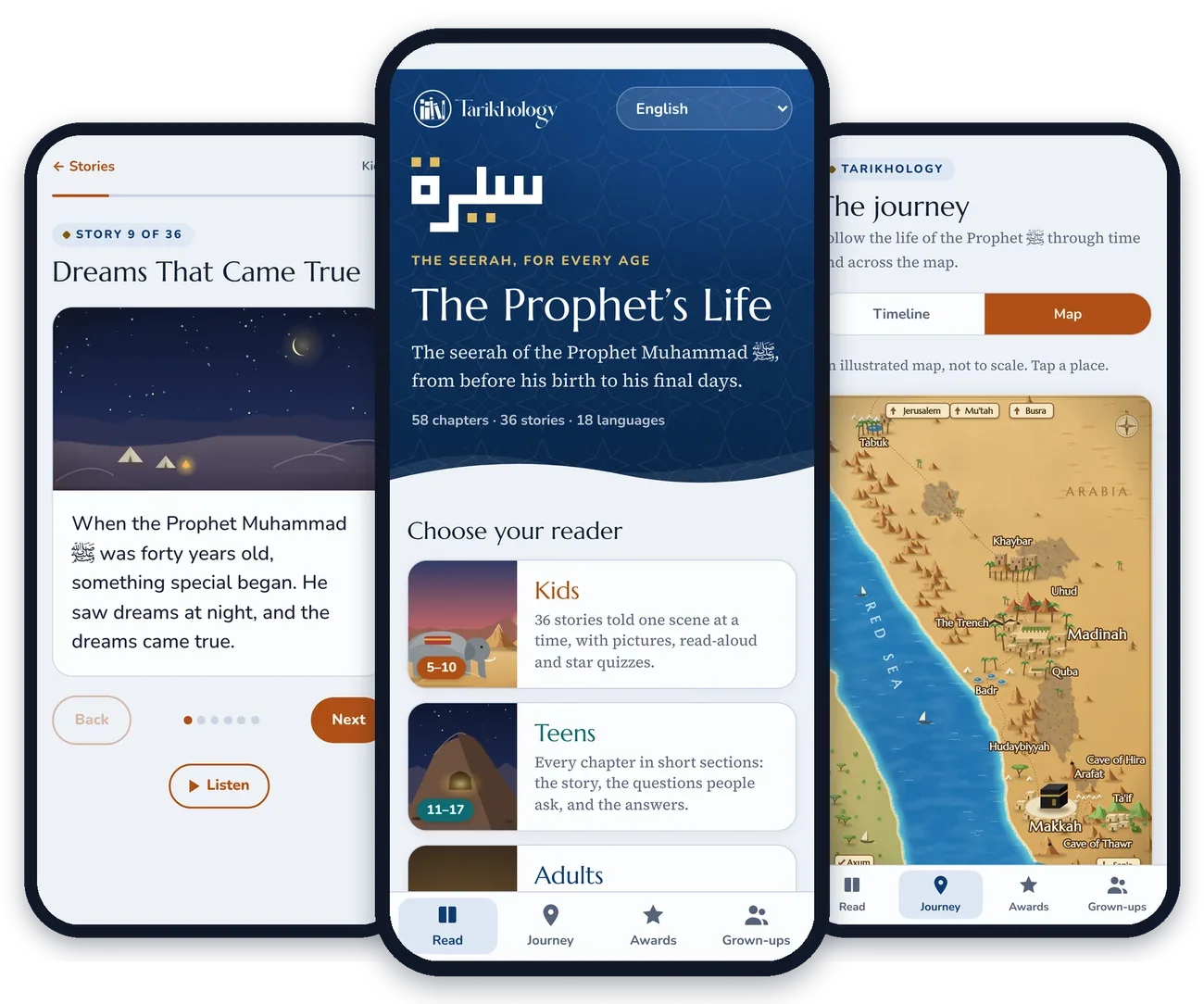
The Sīrah as an interactive app: readers for kids, teens and grown-ups, narration, a quiz after every chapter, and text in eighteen languages. Based on The Misrepresented Prophet.
About the app -
III
The Podcast
Long-form conversations with teachers, analysts and converts about the questions people actually ask — and the history that answers them.
Listen -
IV
Documentaries
Feature-length films that tell one chapter of history the way the chroniclers recorded it — beginning with Sultan Mehmed II and the taking of Constantinople.
Watch -
V
Sayf Allah Video game
A Tarikhology video game. Ride as Khalid ibn al-Walid through the Ridda Wars, with the record kept beside the action. Coming to PC, PlayStation and Xbox in 2027.
See the game -
VI
Events and courses
Seerah evenings at mosques, workshops for institutions and Tarikhology Academy classes, in person and online.
Upcoming events
Start here
Six essays to begin with.
Short where the record is clear, long where it is contested.
Timeline of the life of the Prophet ﷺ
3 minA summary of the life of the Prophet Muhammad, peace and blessings be upon him, from Makkah to Madinah.
SīrahThe Misrepresented Prophet
EssayThe life of the Prophet Muhammad ﷺ in context, with detailed discussion of contemporary questions in the West.
Contested questionsThe age of A’isha
15 minHer age at marriage is heavily contested by modern sceptics. What the sources say, and how historians weigh them.
Contested questionsThe Battle of al-Jamal
20 minIn defence of A’isha, Talha and al-Zubayr: a time of great confusion, and a point of great debate among historians.
ScriptureExposing Qurʾānic violence
15 minWhy the “religion of peace” seemingly has verses of violence within its scripture — read in their time and place.
ComparativeThe death penalty, contextualised
20 minWhat do the Abrahamic faiths say regarding capital punishment? Torah, Gospel and Qurʾān side by side.
How we work
Answered from the record, not around it.
Tarikhology is a nationally recognised organisation committed to education through history. These are the rules every essay, episode and app chapter is held to.
-
01
From the sources themselves
Claims rest on the classical works — the sīrah literature, the ḥadīth collections, the chronicles — named where they are used, so a sentence can be traced to its page.
-
02
The Arabic beside the English
Where a passage carries the argument, the original wording sits alongside the translation, so you can check the reading for yourself.
-
03
Honest about disagreement
Where historians differ or a date is uncertain, we say so — rather than implying a precision the sources do not have.
The Prophet ﷺ said: “I have only been sent to perfect good character.” 1 The report is carried by Aḥmad in his Musnad and by al-Bayhaqī, and al-Albānī graded it ṣaḥīḥ.
1 Aḥmad, Musnad, 8952; al-Bayhaqī, al-Sunan al-Kubrā, 20782.
What people say
From teachers, students and readers.
Tarikhology and the hard-working team behind the initiative have a dream. It’s bold, beautiful and brilliant. They are educating, entertaining and connecting Muslims in a way that’s going to benefit this Ummah greatly if they persevere.
Amazing work, Alhamdulillah.
Excellent work. Da’wah is something every Muslim should be involved in.
History is important yet underrated. Excellent work.
Begin